A Strategic Performance Area Based Framework for Evaluating Structural Alternatives
Abstract for white paper in development
In recent years, an ever-increasing number of legal market commentators have argued that the traditional partnership model for legal services is becoming outmoded. A range of emerging trends have been identified including the unprecedented size and geographic reach of modern firms, the increased commoditisation of transactional legal services, changing client needs, as well as a wave of regulatory reforms that are opening up opportunities for greater involvement in law firm management to non-legal professionals.
In support of this view, many observers have drawn comparisons to the transformation that has taken place across other professional service industries including accounting, investment banking, and consulting where an ever-growing number of firms have abandoned the partnership model to adopt a corporate governance structure. In many instances this transformation has spurred tremendous growth and profitability and has allowed firms that have incorporated unprecedented access to capital.
This begs the question: Is the adoption of a corporate management structure the future of legal services?
In our view, the complete adoption of a corporate model is not the optimal way forward for legal services. In fact, we maintain that there are key elements of the partnership model that serve as fundamental drivers of law firm performance and are not, therefore, interchangeable with elements of the corporate model. However, the fact remains that there are a number of unique market forces placing considerable strain on the traditional partnership model which can not be ignored. Immutable market changes driven by technology, social trends, persistent growth and new regulation will continue to place pressure on key aspects of the traditional model far into the foreseeable future.
Looking across industries, we see that other professional service firms (PSFs) have faced market pressures over the past two decades that in many cases are not dissimilar to those facing the legal industry today. While we recognise that there are valuable insights to be gained from the experience of other PSFs, this collective experience does not necessarily provide a model to be replicated across legal services or a broad predictor of law’s structural evolution. For this reason, it is our view that law firms must evolve their own unique model that will allow them to 1) successfully adapt to the market environment of the future while 2) preserving the core elements of partnership that define them as an industry and serve as key drivers of sustainable performance.
Our Objective
The overall goal of this project is to provide law firm leaders with original insight and vision to make timely and effective strategic choices regarding the organisation and management of their firms.
Specific objectives for this project include:
1. Synthesise the collective insights derived from PSF leader interviews, our own professional experience, and the existing literature.
2. Take a first step in postulating an alternative framework for assessing the impact of competing law firm management strategies on specific areas of firm performance.
The Strategic Performance Area Model
The need to adapt is not in question. Rather, the question is how law firm leaders can implement policies which enable their firms to successfully adapt and evolve within a changing marketplace while maintaining those aspects of partnership which are critical to the firm’s overall success.

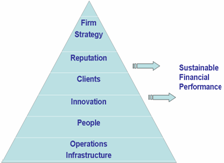
Figure 1Based on our experience advising senior leaders in the legal sector and our team’s own experience in leading some of the world’s foremost consulting organisations, we have identified the following six critical areas that drive sustainable performance in law firms: Strategy, Reputation, Clients, Innovation, People, and Operational Infrastructure.[1]
By understanding the law firm as a set of key performance areas[2] that operate in concert to drive sustainable financial performance, we intend to pinpoint which aspects of the law firm are most affected by competing management strategies. By understanding the impact of structural adaptation at this level, we are able to discern key insights into how specific elements of corporate practices can be successfully applied to maximum effect, without disrupting the critical drivers of performance supported by the partnership structure.
The Annual IBA Conference in Buenos Aires
The initial findings of this project will be presented by John Kelly at the IBA conference on Tuesday the 14th of October from 1500-1800 as a part of a broader panel discussion on the issue of corporate practices in law partnerships. For more information about this project or to request a copy of the completed study, please contact Bridge Consulting International at bridge@bcillp.com.
To express your views on the issue, visit www.bcillp.com and join the discussion on the Law Firm Management Forum.
[1]The performance area model is based on research conducted jointly with Allen & Overy and Bridge that is being further developed in a joint effort with the Law Society of England & Wales around measuring success in law firms. http://www.bcillp.com/bridge/home/law_society/
[2] Each area shown in the model represents a comprehensive set of business processes that constitute the firm’s operation. As the deconstruction of overall firm performance into a series of micro-processes is not the aim of this project (nor an approach appropriate for analysing professional service firms), we will not attempt to address the impact of competing management approaches at the micro-process level.